


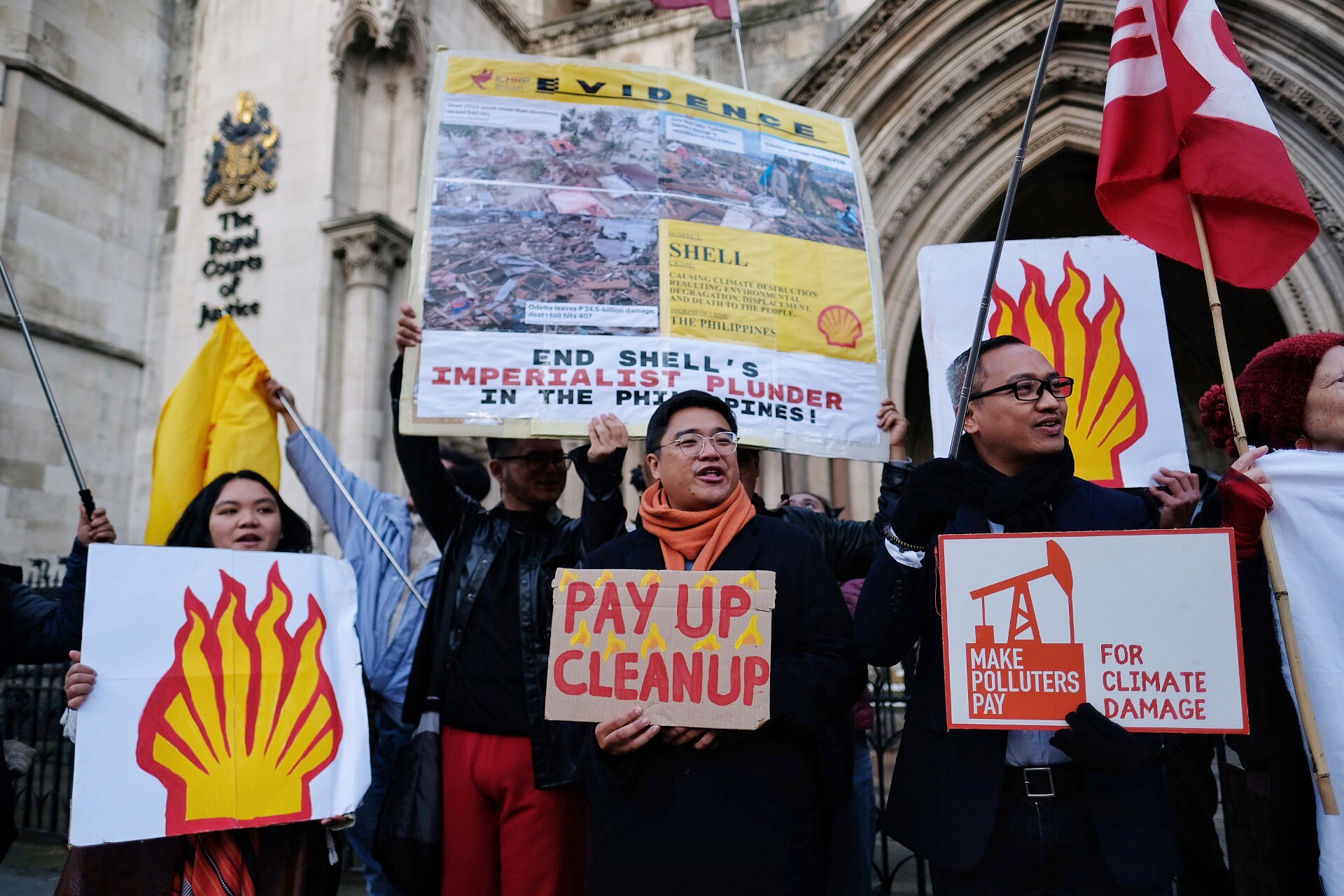
Oil giant Shell has announced that it made $18.5 billion (£13.6 billion) in profit in 2025. To put that in context, if you made £10,000 every day, it would take at least 3,712 years to make as much as Shell did.
We all know there’s vast inequality in who makes what money, so why are we talking about Shell in particular?
The answer is that Shell is making these astronomical profits from a business model that is fuelling climate change, with devastating impacts. As fossil fuel pollution raises temperatures, extreme weather events are becoming more common and more intense.1 And when heatwaves, typhoons, and floods hit, it's ordinary people who are left to pick up the pieces.
In December 2021, Typhoon Odette rapidly intensified from a Category-1 storm to a Category-5 Super Typhoon, just one day before making landfall in the Philippines. In that short time, wind speeds increased by 85mph. It was near impossible for people to prepare or evacuate.2
Scientists have studied Typhoon Odette, and found that human-caused climate change roughly doubled the likelihood of an extreme weather event like Odette, as well as making it more damaging.3
Which brings us back to Shell, one of the world's biggest historical polluters, undeniably contributing to the climate crisis and driving these disasters.
Madeleine Lynch, Campaigner at the Odette Case, said:
“Shell’s profits are inextricably linked to the extreme weather we are now witnessing around the world – from the heatwave in Australia to repeated flooding leading to homes being demolished in Wales.
“It is scandalous that this is allowed to continue. For years, Shell knew fossil fuels could cause dangerous climate change. It had the chance to change course. Instead, it misled the public and helped block our shift to clean energy, all to protect its profits.
“But people are now standing up to Shell, including a group in the Philippines that suffered from the devastation caused by Super Typhoon Odette in 2021, who are now taking Shell to court for its contribution to this disaster.
“Shell’s role in fuelling the climate crisis is undeniable. And yet it continues to prioritise profits and shareholder pay outs over climate action.”
Greenpeace Philippines Climate Campaigner Jefferson Chua said:
"These obscene profits of fossil fuel companies are grossly unfair—benefiting only a few while placing the majority at the receiving end of extreme weather events.
"They regularly force frontline communities and the government to break the bank even after barely recovering from the loss and damage they’ve incurred from the past storms, burying them deeper in debt. Even Malacañang has acknowledged that climate change has contributed to the country’s worst economic slump in decades—this should already be a wake-up call.4
“Let us not wait for the economic costs and death toll to pile up further before we recognize that people’s welfare must come before corporate profits. We call on President Ferdinand Marcos Jr. to urgently hasten the fossil fuel phase-out and make climate justice a national priority. Corporations like Shell must be held accountable.
“We urge President Ferdinand Marcos Jr. to stand with communities seeking justice from climate polluters like Shell, and push Congress to fast-track the Climate Accountability (CLIMA) Bill, which would compel major carbon-polluting companies to compensate communities for climate-related loss and damage.”5
It's high time Shell pays for its share of the damage from climate impacts.
SOURCES
[1] How climate change worsens heatwaves, droughts, wildfires and floods (BBC)
How do hurricanes or typhoons form and are they getting stronger? (BBC)
[2] Super Typhoon Odette (Rai) (Center for Disaster Philanthropy)
[3] Clarke, B., Li, S., Toumi, R., and Sparks, N.: The influence of anthropogenic climate change on Super Typhoon Odette (Typhoon Rai) and its impacts in the Philippines, EGUsphere [preprint], https://doi.org/10.5194/egusphere-2025-665, 2025.
[4] Marcos Jr. attributes PH's growth slump to climate change, corruption probe (ABS-CBN)
[5] Landmark climate accountability law to make corporate polluters pay pushed in Congress (Greenpeace Philippines)